Faucet & Sink Repair
Stop drips and weak flow, free stuck valves and repair leaking outdoor hose bibs.
A disposal that hums, jams or drips under the sink is usually fixable. Some problems call for a reset, and others for a new unit. Turn off any unit that drips into the cabinet or forces water up the dishwasher hose.
Cut power to the disposal at the wall before anything goes near the drain.
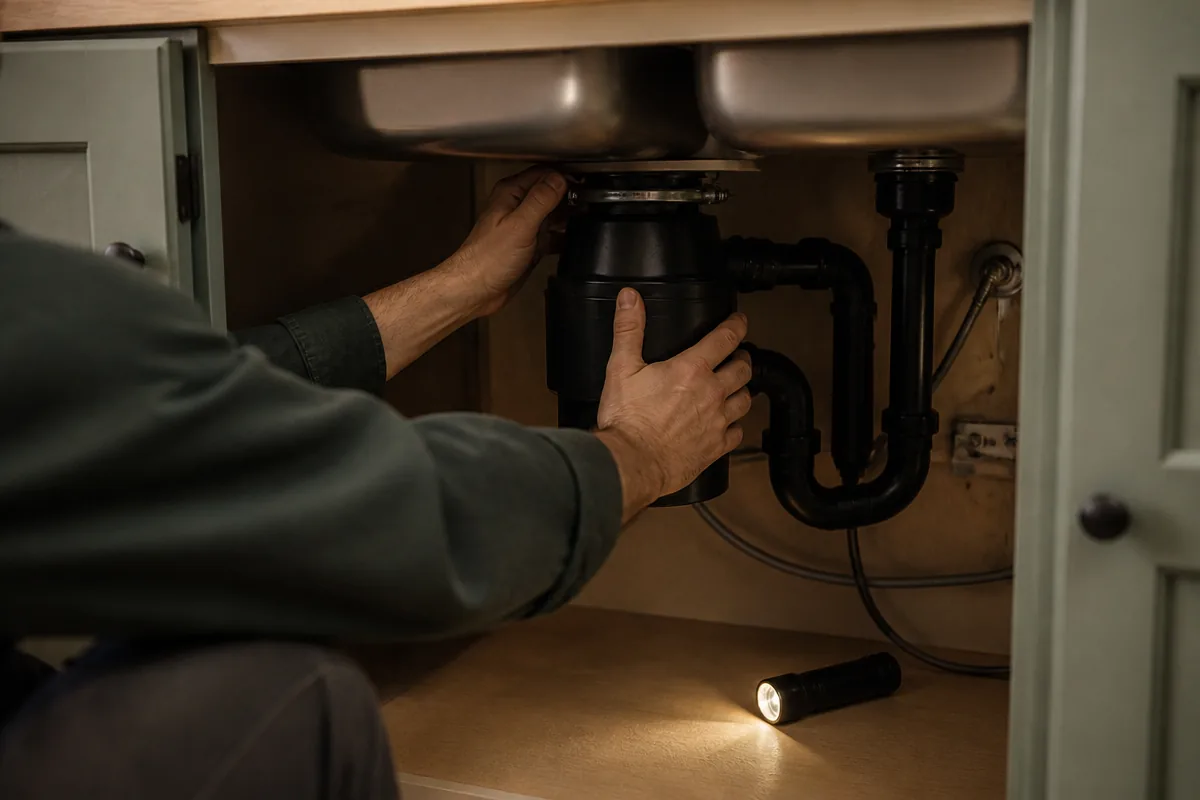
A humming disposal has a jam. Switch it off at the wall and use the hex socket in the bottom to turn the blades back and forth. Remove any object you can see with tongs, never fingers.
A silent unit may only need the red reset button on its underside pressed. If the reset keeps tripping, the motor is suspect and the unit could be close to done.
Check where the water shows up. A leak at the top is the sink flange, one at the side is the dishwasher or drain connection, and one at the bottom may be a crack in the housing.
Flange and gasket leaks are often repairable. A cracked housing means replacement.
Disposal work is among the simpler jobs. Price depends on these things.
Ask if disposal and haul-away of the old unit are included in the quote.
Mineral scale from hard water can coat the grinding parts and fill small gaps in the housing. A public summary of EPCOR data lists Fountain Hills water at roughly 5.3 grains per gallon.
Running a few ice cubes with citrus peel can scrub the chamber. If the smell stays, the problem may be in the drain line, not the unit.
Disposals are rated by motor size. Larger motors handle tougher scraps and run quieter, while basic models suit light use. Continuous-feed and batch-feed models differ in how they start.
Check the available space under the sink. A larger unit may collide with a drain trap or shelf, so measure before choosing.
Run cold water before, during and after use. Avoid grease, coffee grounds, fibrous scraps and large bones, since they cause clogs further down the drain.
The Fountain Hills Sanitary District asks residents not to pour fats, oils or grease down drains. A disposal grinds food but does not make grease safe to send into the line.
Look at the mounting style and the sink drain. Most disposals use a standard three-bolt mount, but older sinks and some dishwashers need adapters. Note the brand and horsepower of the current unit so the replacement is a clean match.
A disposal needs an electrical connection, either a plug under the sink or a hardwired box. If neither exists, an electrician may need to add one, and the dishwasher drain has to connect to the disposal inlet with the knockout plug removed, a step that is easy to forget.
Run cold water while the unit is working and for several seconds afterward so that scraps clear the trap. Feed it small amounts at a time, and avoid grease, coffee grounds in bulk, fibrous stalks and bones. Citrus peels will freshen the smell without harming the unit.
If the unit hums but does not spin, switch it off at the wall, then turn the hex fitting under the unit using a wrench so the blades turn. Pressing the reset button comes after that, and never put your hand inside.
Most failures are one of a handful of causes.
Turn the switch off and, if you can, cut power at the breaker. Never put a hand in the opening. Look for the jam with a flashlight and use tongs.
If the unit hums, a hex wrench in the bottom socket can turn the blades free. Afterward, press the red reset. If it trips again, the motor may have failed.
A leak from the bottom is the end of the unit. Seepage at the sink flange or a drain connection can often be cured with a tighter fit or a fresh seal.
Disposals are inexpensive compared with other fixtures, and an old unit with a failing motor is usually better replaced. If you replace it, ask about horsepower, the mounting type and whether a dishwasher connection must be reopened.
Some callers want a leaking line under the sink fixed or a disposal removed. Both are routine jobs, and the dispatcher can quote them. If a drain beyond the unit is blocked, the drain cleaning page applies.
Stop drips and weak flow, free stuck valves and repair leaking outdoor hose bibs.
Unblock a backed-up sink, tub, laundry or main drain and trace what caused the clog.
Whole-house and under-sink filters for taste, odor and sediment.
The blades are jammed. Switch it off, turn the blades with the hex wrench from below and remove the object.
A leak from the flange or a gasket can often be fixed. A crack in the housing means replacement.
Grease, coffee grounds, bones, fibrous foods like celery, and anything that is not food. These cause clogs further down the line.
Yes. Scraps that do not clear can lodge in the trap or the line and cause a slow drain.
Switch it off, empty the cabinet and call the line. Seepage at the flange, a gasket or a drain joint is frequently fixable, whereas a split housing means buying a new disposal.
Something is jammed. Turn it off, remove the object and turn the blades by hand with a wrench, then press reset.
A leak at the top or the drain connection often can. A leak from the bottom of the housing means replacement.
A modest repair on a sound unit makes sense. If the motor is failing or the housing leaks, replacement is the better value.
Grease, fibrous scraps, coffee grounds in quantity, bones and starchy foods can all clog the line.
Yes. The crew reconnects the drain and caps the dishwasher port if needed.
Turn it off, ring the 24/7 line and report what you are seeing.
Service area centered on Fountain Hills and nearby Maricopa County cities.