Water Filtration Installation
Whole-house and under-sink filters for taste, odor and sediment.
Hard water leaves white crust on faucets, spots on glass and scale inside heaters. A softener removes the minerals that cause it, if it is sized and set up properly.
Mention the number of people in the home and the model of any existing softener.
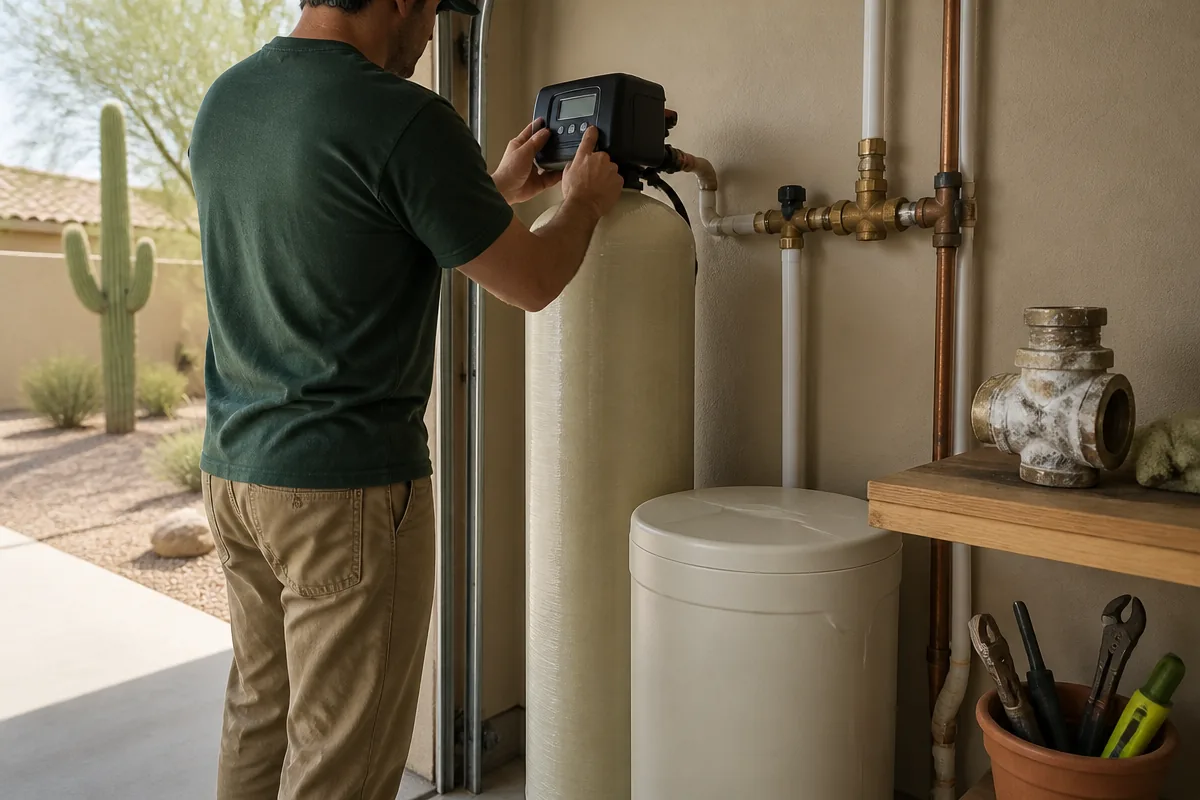
Water runs across resin beads in a softener, and the beads exchange calcium and magnesium for sodium or potassium. The beads fill up, so the unit periodically recharges with brine and flushes the minerals down the drain.
Household water use and hardness determine the size. A small unit regenerates constantly, and an oversized one burns through salt.
Salt-based softeners remove hardness minerals. Salt-free conditioners change how minerals form scale, and they leave the minerals in the water.
Both have supporters. Ask the installer what each will and will not do for your fixtures, and what upkeep it needs.
Softeners range from basic to feature-rich. These items move the price.
Ask the contractor for a hardness reading at your tap and how it sized the unit.
EPCOR supplies Fountain Hills water, and a public summary of its data puts hardness at about 5.3 grains per gallon. That counts as moderately hard, and it is the level where scale starts to be a household nuisance.
Check the EPCOR water quality report for current figures, and test your own tap if you want a number. If your community has rules on softener discharge, ask your HOA or the District before installing.
Placement needs space close to the main line, a drain for the regeneration water and a power outlet. Bypass valves let you isolate the unit for service or for outdoor taps.
Ask about plumbing the outdoor spigots ahead of the softener, so the lawn does not get softened water.
Typical failures are a stuck valve, a salt bridge that stops brine flowing, tired resin and a dead control board. Adding salt and cleaning the brine tank solves a surprising share of problems.
The resin tires with age, so older units may lose capacity. A hardness test after the softener shows if it is still working.
A softener works from a brine tank, and the salt level should stay above the water line. Check it monthly. A hard crust across the surface, called a bridge, can leave a gap beneath it so that the unit runs out of brine while the tank looks full. Breaking the crust with a broom handle usually restores the cycle.
The resin inside a softener tires over the years, and chlorinated supply water hastens that. If the water turns hard again even though salt and settings are right, the resin may be spent. A plumber can test the hardness of the water coming out of the unit and tell you whether the resin or the control valve is at fault.
Each regeneration flushes salty water to a drain, and the drain connection has to meet code. Some communities restrict where softener discharge may go, and a home on a septic tank needs a different plan than one on a sewer. Ask the contractor to confirm the rules for your address before the unit goes in.
Placement matters too. The softener belongs downstream of the main shutoff and upstream of the water heater, with a bypass valve so you can isolate it. Keep outdoor spigots on untreated water so irrigation does not waste salt.
A softener that stops working is easy to miss because water still flows.
Valves, seals and control heads wear out before the tank does. Replacing a head or a valve is often the sensible repair. An older unit with fading resin and a failing control may not be worth another repair.
Callers sometimes ask about stuck objects in the brine tank or a salt bridge, a crust that hides empty space below. Breaking the bridge usually restores the cycle, and a plumber can check the rest.
Keep the brand and model ready. Parts for common brands are easier to find than for discontinued units.
A softener removes the minerals that cause scale. A conditioner changes how scale forms without removing it. A filter targets taste, chlorine or sediment. Each solves a different problem, and the filtration page covers the filters.
Before you buy, ask what hardness the system is rated for and where the brine drains. Home buyers can also ask for the unit to be inspected before closing, since a failed softener is a repair cost.
Whole-house and under-sink filters for taste, odor and sediment.
Descale the heat exchanger, decode error messages and repair or replace on-demand units.
Diagnose cold showers, a dripping tank, a rumbling heater, or a pilot or element fault.
A public summary of EPCOR data lists about 5.3 grains per gallon, which counts as moderately hard. Test your own tap for an exact figure.
Treated water carries a little extra sodium or potassium. People on a restricted sodium diet should ask a doctor, and some owners put a drinking tap before the softener.
It depends on the model and your water use. Check the brine tank each month and refill when it runs low.
A salt bridge, a stuck valve or tired resin can all reduce performance. A test after the unit shows whether it is working.
Yes, the line is always answered. Switch a leaking softener to bypass or shut its supply valve, then place your call.
Some water is normal. Too much, or a tank that overflows, suggests a stuck float or a valve problem.
If the control head or valve has failed on a unit that is otherwise sound, repair is reasonable. An old tank with worn resin usually is not.
Ask when you call. The plumber can check the settings, the salt, the drain and obvious leaks.
A hard crust of salt that forms above empty space in the tank. The unit looks full but is not making brine. Breaking it up usually fixes it.
Softened water reduces scale in the heat exchanger, which helps the heater last.
Call and describe your fixtures and your water. A dispatcher will help you reach a contractor.
Service area centered on Fountain Hills and nearby Maricopa County cities.