Water Heater Repair
Diagnose cold showers, a dripping tank, a rumbling heater, or a pilot or element fault.
Tankless units heat water on demand, which saves space and tank standby loss. In mineral-rich water, they also need regular flushing to keep working.
Keep the model number and any displayed error code ready for the call.
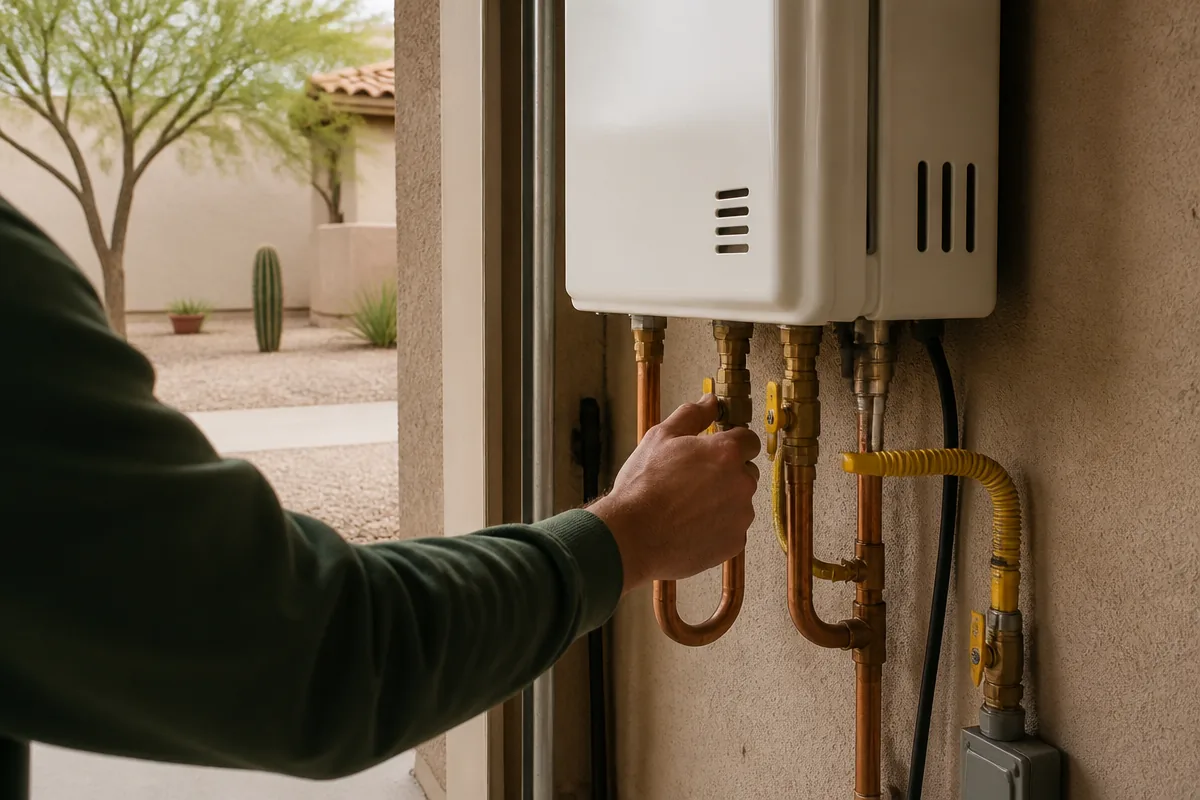
The heat exchanger sits in a narrow path, so minerals in the water coat it faster than they would a tank. A coated exchanger slows heat transfer and can trigger error codes.
Makers generally recommend a yearly flush where water is hard. The plumber circulates a descaling solution through the unit and rinses it clean.
Each brand uses its own codes, and the manual lists them. Common causes include a blocked vent, low gas pressure, a dirty inlet screen or a failed flow sensor.
Resetting the unit once is reasonable. If the code returns, a technician should find the cause rather than clearing it again and again.
A public summary of EPCOR data lists Fountain Hills water at about 5.3 grains per gallon, which counts as moderately hard. That is enough to leave scale inside a tankless exchanger over a few years.
Venting and gas supply matter too. Arizona garages run hot, so check that the vent path and combustion air stay clear.
Service on tankless units is more specialized than a tank repair. Prices depend on these points.
Ask whether the flush includes cleaning the inlet filter and whether you receive a service note.
Units have a flow rate limit, so running a shower, a washer and a dishwasher at once can overload a small model. Know the unit's rating before blaming the heater.
Recirculation loops and small buffer tanks can reduce the wait for hot water. Ask your plumber if they suit your layout.
Tankless heaters often last longer than tanks when maintained, and many parts can be replaced. A unit with a cracked heat exchanger or repeated board failures is a different story.
Ask for the repair estimate next to the cost of a new unit, and ask about the warranty status.
On-demand heaters push all the water through narrow passages inside a heat exchanger. Minerals build up on those surfaces and cut flow and efficiency, which is why error codes tied to temperature or ignition often start after a few years. A plumber clears the buildup by circulating a mild descaler through the heat exchanger.
Look at the inlet filter screen as well. Grit trapped there starves the unit of water and can trigger a fault. Cleaning it takes a few minutes with the water off.
A gas tankless heater needs a vent sized for its exhaust and a gas line sized for its burners. A line that served a tank heater may be too small for a unit that fires at a much higher rate. If the heater cycles off at high demand, a short gas supply is a common cause.
Leave open space around the unit and the vent terminal unobstructed. Birds, spiders and debris can block a vent and cause a safety shutdown.
These patterns usually mean scale or a sensor fault.
A flush circulates a mild descaling solution through the heat exchanger and then rinses it. Hard water speeds up scale, so units on a hard supply need attention more often than the manual suggests. Fountain Hills water is described as moderately hard, and a softener helps, as the softener page explains.
Clean the inlet screen when the manual allows. Leave open space around the unit and keep the vent free of debris. Ask the plumber how often your model should be flushed, because brands differ.
Service pricing depends on the model, the fault and how scaled the unit is, and the dispatcher can quote before the visit. Parts for some brands may take time to obtain, so ask about timing.
Units that are still under a manufacturer warranty may qualify for covered parts, so keep the model and serial number handy. When an exchanger is damaged beyond a flush, the repair may approach the cost of a new unit. The replacement page compares the choices.
Callers also ask about converting from a tank to tankless, or about heat pump models. Those jobs depend on gas supply, venting and electrical capacity, so the answer comes after a look at the house.
Diagnose cold showers, a dripping tank, a rumbling heater, or a pilot or element fault.
Install a softener, or revive an aging one, so hard water stops scaling your fixtures.
Replace a failing tank and choose the capacity, fuel and location of the next one.
Where water is hard, many makers recommend descaling yearly. Read the manual for your model and ask a technician how local water affects it.
Between two uses, the water in the pipes cools, and a unit needs a moment to relight. Recirculation or a small buffer tank can reduce this.
Some owners manage it with a small pump and descaling fluid, though gas and electrical parts are involved. A technician handles it safely and checks the vent.
Softening reduces scale, which can lengthen the life of the unit. Check the warranty terms, since some brands list water quality conditions.
Call any time. If a unit leaks or smells of gas, shut it off before doing anything else. Visit timing depends on the contractor.
It depends on water hardness and the model. In a hard water area, many owners flush once a year, but check the manual and ask the plumber.
Each code names a fault, such as ignition, flow, venting or a sensor. Write the code down and give it to the dispatcher.
Handy owners sometimes use a pump kit. A plumber is safer when the unit is hard to reach or the valves are stiff.
Mention the brand and model on the call. Parts access varies, and the dispatcher can say what the crew can handle.
Not always. Gas line size, venting and power needs can differ, so the plumber inspects the setup first.
Call and read out the code and model. A dispatcher will help find the right contractor.
Service area centered on Fountain Hills and nearby Maricopa County cities.